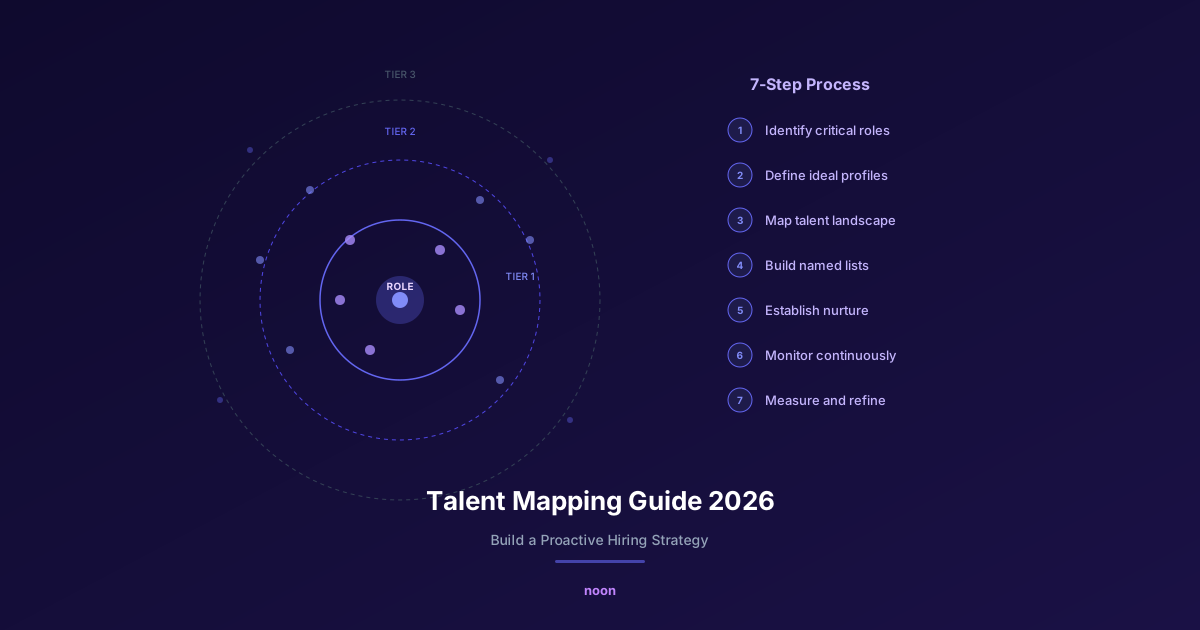
Key takeaway: Talent mapping identifies the supply, location, compensation, and movement patterns of target talent pools before you have open roles. It answers four questions: where does the talent sit (companies, geographies), what do they earn, how often do they move, and what triggers a move? Teams that talent-map quarterly fill senior roles 50% faster than teams that source reactively.
Talent mapping is one of those HR concepts that sounds sophisticated in presentations and rarely survives contact with reality. The idea is compelling: identify the roles you'll need, understand where the talent lives, and build relationships before requisitions open. In practice, most organizations don't get past step one. While our candidate sourcing guide covers the full range of reactive and proactive approaches, this article focuses specifically on the strategic workforce planning required to build talent pipelines before roles open.
McKinsey's 2025 HR Monitor found that only 12% of U.S. HR leaders run strategic workforce planning with a three-year horizon. The World Economic Forum's 2025 Future of Jobs report found that 63% of employers cite skills gaps as the primary barrier to business transformation. And EY's Work Reimagined Survey found that organizations with strategically advantaged people functions financially outperform peers by 5.8x.
The gap is clear: the companies that plan ahead win. Most companies don't plan ahead. The question is how to close that gap without turning talent mapping into a six-month project that produces a beautiful document nobody uses.
This guide covers the practical 7-step process that moves talent mapping from concept to operation — including how AI makes each step feasible for teams that don't have dedicated workforce planning resources.
What talent mapping is (and what it isn't)
Talent mapping answers three questions:
Which roles are most critical to the business? Not every role needs a proactive pipeline. Talent mapping identifies the roles where a vacancy causes the most business impact.
Where does the talent for those roles actually live? What companies employ them? What geographies? What skill adjacencies exist? What does compensation look like?
Who, specifically, would you want to hire if a role opened tomorrow? Named individuals who are qualified, potentially interested, and reachable.
What it isn't:
- It's not a succession plan. Succession planning is internal — who replaces the VP of Engineering if they leave. Talent mapping is external — who could you hire from the market.
- It's not a job description. Job descriptions define what a role requires. Talent mapping identifies where the people who meet those requirements actually work.
- It's not a one-time exercise. A talent map that was accurate in January is outdated by April. People change jobs, acquire new skills, relocate, and shift career interests. The map needs continuous updating.
The 7-step talent mapping process
Step 1: Identify critical roles
Not every role needs proactive mapping. Focus on roles that are:
- High-impact: Vacancies directly affect revenue, product delivery, or customer experience
- Hard-to-fill: Historical time-to-fill exceeds 45 days, or the talent pool is small
- Recurring: Roles you've hired for before and will likely hire for again
- Growth-driven: Roles you know you'll need as the company scales
A typical organization has 5-10 critical role types that account for 80% of hiring difficulty. Start there.
How to prioritize: Build a 2x2 matrix of Business Impact (high/low) × Hiring Difficulty (high/low). The high-impact, high-difficulty quadrant gets mapped first. The low-impact, low-difficulty quadrant doesn't need proactive mapping at all.
Step 2: Define the ideal candidate profile
For each critical role, build a profile that goes beyond the job description:
- Core skills: The non-negotiable technical and functional skills
- Experience patterns: What career trajectories indicate success in this role? (e.g., "3-5 years at a growth-stage SaaS company, promoted at least once")
- Company signals: What types of companies produce strong candidates? (e.g., "Series B-D startups in fintech or healthtech")
- Cultural indicators: Work style, pace, communication preferences that align with your team
- Anti-patterns: Traits or backgrounds that have historically not worked (with careful bias checking)
The ideal candidate profile should be informed by data from past successful hires, hiring manager input, and market reality.
Step 3: Map the talent market
With profiles defined, map where the talent actually lives:
Company mapping: Which companies employ the most people who match your profile? These are your "talent source companies." For an enterprise sales role, it might be Salesforce, HubSpot, Snowflake, and Datadog. For a senior ML engineer, it might be Google DeepMind, Meta FAIR, and mid-stage AI startups.
Geographic mapping: Where are qualified candidates concentrated? Are you limiting yourself geographically without reason? What markets have an oversupply of talent that other companies aren't tapping?
Compensation mapping: What are candidates in this profile earning? How does your compensation compare? If you're 20% below market, your proactive pipeline will be 20% harder to convert.
Supply-demand analysis: How many qualified candidates exist relative to the number of companies competing for them? If the ratio is unfavorable (more demand than supply), you need a longer nurture horizon and more compelling value proposition.
AI tools dramatically accelerate this step. Noon's search across multiple professional data sources can map the talent market for a role type in hours, identifying candidate concentrations by company, geography, and skill profile. That is work that would take a researcher weeks to do manually.
Step 4: Build named candidate lists
Move from abstract profiles to specific people. For each critical role, maintain a list of 60-110 named candidates who meet your profile criteria.
Tiering:
- Tier 1 (10-20 candidates): Strong matches you'd reach out to immediately if a role opened. These are candidates you want to nurture actively.
- Tier 2 (20-40 candidates): Good matches with some gaps — might need more experience, are in non-adjacent industries, or require relocation. Nurture passively.
- Tier 3 (30-50 candidates): Emerging talent who could be Tier 1 in 1-2 years. Long-term relationship building.
Step 5: Establish nurture touchpoints
A talent map without nurture is a static database that goes stale. The nurture cadence keeps relationships warm:
Tier 1 — Monthly touchpoints:
- Share relevant industry content, company news, team accomplishments
- Invite to company events, webinars, or informal coffee chats
- Congratulate on career milestones (promotions, work anniversaries, published work)
- Keep communication personal and value-adding — not recruitment pitches
Tier 2 — Quarterly touchpoints:
- Share broader industry trends and company updates
- Maintain visibility without being intrusive
- Move to Tier 1 if engagement signals increase
Tier 3 — Semi-annual touchpoints:
- Light-touch content sharing
- Monitor career progression
- Upgrade as they gain experience
Step 6: Monitor and update continuously
Talent maps decay. People change jobs (average tenure is 3-4 years), develop new skills, relocate, and change career priorities. A quarterly refresh prevents the map from becoming fiction.
What to monitor:
- Job changes among Tier 1 candidates (a change might make them more or less reachable)
- New entrants to the market (people who recently acquired relevant skills or certifications)
- Company changes (acquisitions, layoffs, restructurings that put talent in motion)
- Compensation shifts (market adjustments that affect your competitiveness)
AI makes continuous monitoring feasible. Noon tracks candidate movements and signals automatically — flagging when a Tier 1 candidate shows signs of receptivity or when a new high-potential candidate enters the relevant talent pool.
Step 7: Measure and refine
Track the impact of talent mapping on your hiring outcomes:
- Time-to-fill for mapped roles vs. unmapped roles: Expect 40-60% improvement for mapped roles
- Pipeline activation rate: What percentage of mapped candidates enter your active pipeline when roles open?
- Hire rate from mapped pipeline: How many hires come from proactively mapped candidates vs. new sourcing?
- Quality indicators: Are candidates from the mapped pipeline performing better (higher 90-day retention, faster ramp times)?
Use these metrics to refine your mapping criteria, nurture cadence, and role prioritization.
How AI transforms talent mapping
Traditional talent mapping requires dedicated workforce planning analysts, hours of LinkedIn research, manual candidate tracking in spreadsheets, and quarterly refresh cycles that often get deprioritized when recruiting teams are busy with active reqs.
AI changes the economics of talent mapping in four ways:
1. Automated market analysis: Instead of a researcher spending 20 hours mapping the senior data engineer talent pool, an AI agent scans multiple data sources and produces a comprehensive market analysis in hours: candidate volumes by company, geography, skill profile, and compensation range.
2. Continuous monitoring: AI tracks candidate movements in real time. When a Tier 1 candidate changes roles, updates their profile, or shows increased activity, the system updates the map and surfaces an alert.
3. Dynamic list maintenance: As candidates move between tiers (a Tier 2 candidate gets promoted and is now a Tier 1 match), the AI reclassifies them automatically based on updated profile data.
4. Nurture automation: AI handles the nurture cadence — sending personalized touchpoints at the right intervals, adjusting timing based on engagement signals, and escalating candidates who show increased interest.
At Noon, talent mapping is embedded in the sourcing workflow. When you configure Noon for a role type, the system continuously maps the talent market, maintains candidate lists, and nurtures relationships, all autonomously. When a req opens, the pipeline is already warm. If you're ready to see how autonomous talent mapping works for your critical roles, you can book a demo to walk through the workflow.
Common talent mapping mistakes
Mapping too many roles: Start with 5-10 critical role types. Mapping 50 roles produces a document, not a practice. Focus creates depth; breadth creates overhead.
Treating it as a one-time project: Talent mapping is an ongoing practice, not a deliverable. If the output is a PowerPoint that goes in a shared drive, it's already outdated. The output should be a living pipeline in your CRM or sourcing platform.
Ignoring compensation reality: A beautiful talent map is useless if your compensation is 30% below what mapped candidates earn. Include compensation data in the map and flag roles where you're not competitive.
Over-personalizing too early: Don't write detailed dossiers on 100 candidates. Start with data-driven profiles, tier them, and invest personal research time in Tier 1 candidates only.
FAQ
What is talent mapping in recruitment? Talent mapping is the process of identifying critical roles, understanding where qualified talent lives in the market, building named candidate lists, and nurturing relationships proactively — so that when roles open, there's a warm pipeline ready to activate. Only 12% of HR leaders currently do this strategically (McKinsey 2025), but those who do outperform peers by 5.8x (EY).
How is talent mapping different from sourcing? Sourcing is reactive: finding candidates for an open role. Talent mapping is proactive: building a picture of the talent market and nurturing candidates before roles exist. Talent mapping feeds sourcing: when a role opens, the mapped pipeline provides a head start that eliminates weeks of sourcing time.
What tools are used for talent mapping? Traditional tools include LinkedIn Recruiter, CRM platforms (Gem, Beamery), and spreadsheets. AI-powered tools like Noon automate the process — continuously scanning for qualified candidates, monitoring movements, and maintaining warm pipelines without manual recruiter effort. The advantage of AI is that it makes talent mapping feasible for teams without dedicated workforce planning resources.
How often should a talent map be updated? Continuously, if using AI tools. If updating manually, quarterly at minimum — with monthly monitoring of Tier 1 candidates. The talent market moves fast enough that a map that's 6+ months old is fiction, not strategy.
How many roles should be talent mapped? Start with 5-10 critical role types — high-impact, hard-to-fill roles that recur. Expand gradually as the practice matures. Trying to map every role at once produces breadth without depth. Focus on the roles where a warm pipeline creates the most business value.