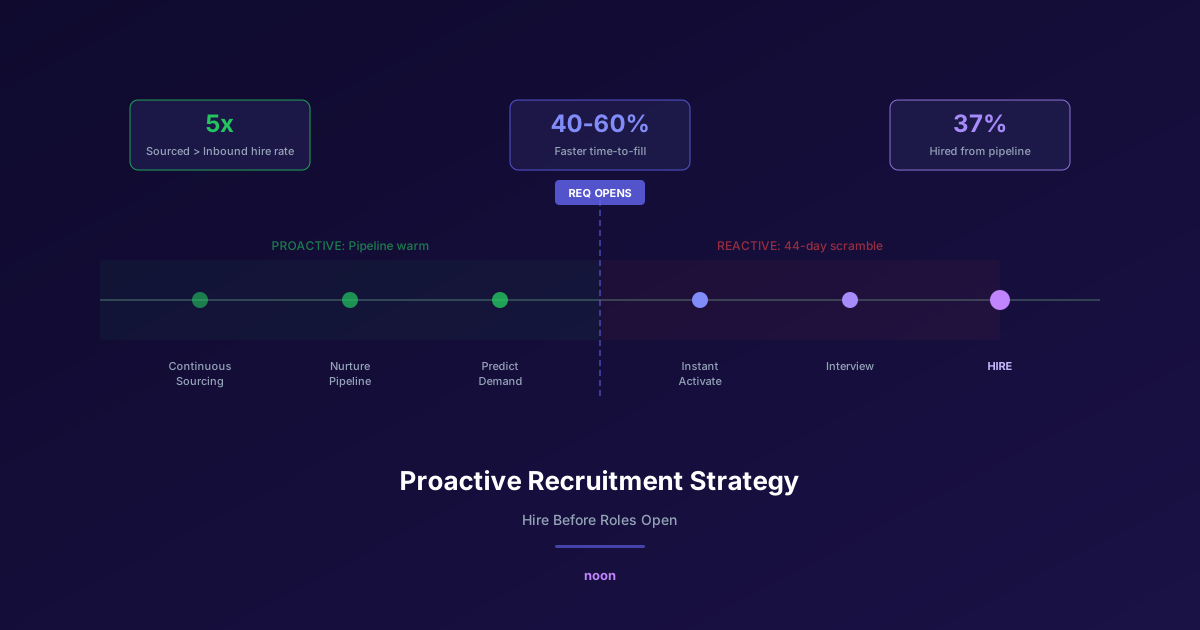
Key takeaway: Proactive recruitment — sourcing and engaging candidates before roles open — reduces time-to-fill by 40-60% and improves quality-of-hire by 25%. The three pillars are: building always-warm talent pools by function, running continuous passive outreach sequences, and maintaining hiring manager alignment through quarterly talent mapping sessions.
The moment a requisition opens, the clock starts. Average time-to-fill across U.S. companies is 44 days (SHRM 2025), and every empty week costs $1,000-2,250 in lost productivity, delayed projects, and overloaded team members. For engineering and technical roles, the number climbs to 62 days (Gem 2026).
Most organizations accept this timeline as given. A role opens, sourcing begins, candidates enter the pipeline, interviews happen, an offer goes out. The 44-day clock is treated as an optimization target — how do we shave a few days off?
Proactive recruitment asks a different question: What if you started the sourcing before the role opened?
The concept is straightforward. Instead of waiting for a requisition to begin building a pipeline, you identify likely future hiring needs, source candidates in advance, nurture relationships, and maintain warm pipelines that can be activated the moment a role opens. This is one of the most powerful strategies covered in our candidate sourcing guide, which explores the full spectrum of sourcing approaches. The result: time-to-fill drops by 40-60% because the sourcing phase — which typically accounts for half of total time-to-fill — has already happened.
The data backs this up. Gem's 2025 Recruiting Benchmarks found that sourced candidates are 5x more likely to be hired than inbound applicants. And iHire's 2025 State of Online Recruiting survey found that 36.9% of employers hired directly from their existing pipeline — while 42.3% promoted from within. Teams with warm pipelines fill roles faster, with better candidates, at lower cost.
Yet according to HR.com's 2025 Future of Talent Acquisition report, 51% of organizations still rely on reactive, just-in-time hiring. The gap between proactive and reactive teams is widening.
Why reactive hiring costs more than you think
The visible cost of reactive hiring is time-to-fill. The hidden costs are larger:
Lost productivity: Every day a role sits unfilled, the work either doesn't get done or falls on existing team members. For a senior engineer billing at $120/hour, a 60-day vacancy represents $57,600 in lost or redistributed productivity.
Compromised quality: When a role has been open for six weeks and the hiring manager is pressuring for candidates, standards slip. Teams make "good enough" hires instead of waiting for the right candidate. The 46% first-18-month failure rate (Leadership IQ) is partly a quality problem driven by urgency.
Higher costs: Urgent hiring leads to premium job board spend, agency fees (20-25% of first-year salary), and signing bonuses that wouldn't be necessary if the pipeline was warm. A single agency placement for a $150,000 role costs $30,000-37,500.
Candidate experience damage: Rushed processes — compressed interview timelines, delayed feedback, inconsistent communication — damage employer brand. And in 2026, candidates talk. A bad interview experience reaches 10-15 people through word of mouth and reviews.
The 5-step proactive recruitment framework
Step 1: Identify predictable hiring needs
Not all hiring needs are unpredictable. Many are highly forecastable:
Attrition-driven roles: If your engineering team has 15% annual attrition, you'll need to replace roughly 15% of the team each year. You know this in January. You shouldn't wait until an engineer gives notice in June to start sourcing.
Growth-driven roles: If the company's hiring plan calls for 20 new salespeople in H2, the sourcing should start in H1 — not when the headcount approvals come through.
Seasonal patterns: If your retail organization always hires 200 seasonal workers in September, the sourcing should begin in July.
Business milestone triggers: A product launch requires additional support staff. A funding round enables new hires. An office expansion needs local talent. These events are planned months in advance.
Work with finance and department heads to build a rolling 6-month hiring forecast. Even a rough forecast is better than no forecast.
Step 2: Source continuously, not episodically
In a reactive model, sourcing happens when a req opens and stops when the req is filled. In a proactive model, sourcing runs continuously — building and refreshing pools of qualified candidates for roles that don't exist yet but likely will.
This doesn't mean recruiters spend all day sourcing for hypothetical roles. It means using tools that source autonomously in the background.
Noon's approach is built for exactly this. When the platform is configured for a role type (e.g., "senior backend engineer" or "enterprise account executive"), it continuously identifies and evaluates qualified candidates — even when no active requisition exists. The moment a req opens, there's already a warm pipeline ready. You can book a demo to see how proactive pipelines work for your most frequent role types.
What continuous sourcing looks like:
- AI searches run daily, identifying new candidates who match your profile
- Candidates are scored and evaluated against your criteria
- Market intelligence accumulates (how many qualified candidates exist, what compensation they typically earn, where they're located)
- The pipeline grows organically without recruiter effort
Step 3: Segment and nurture
Not every proactively sourced candidate is ready for a conversation. Segmentation determines how you engage them:
Ready now: Candidates who've expressed interest, are in transition, or have indicated openness. These go into active nurture — monthly touchpoints, content sharing, invitations to company events.
Future fit: Strong candidates who aren't ready to move. These go into passive nurture — quarterly touchpoints, company updates, industry content. The goal is staying top of mind for when their situation changes.
Silver medalists: Past finalists who weren't selected. These are your warmest pipeline. They've already been through your process and liked the company enough to reach final rounds. A check-in every 2-3 months keeps the relationship alive.
Referral sources: People who may not be candidates themselves but know people who are. Maintain these relationships for their network value.
Step 4: Automate the nurture cadence
Manual nurture doesn't scale. A recruiter managing 30 open reqs cannot also maintain relationships with 200 pipeline candidates across 15 potential future roles. This is where automation becomes essential.
Effective nurture automation:
- Sends personalized content at defined intervals (not generic newsletters)
- Adjusts cadence based on candidate engagement (opens, clicks, replies)
- Surfaces candidates who show increased engagement (might be ready to move)
- Pauses when candidates indicate they're not interested
Noon automates this through its pipeline management. Candidates are nurtured with contextually relevant touchpoints — not marketing blasts — and the system surfaces re-engagement signals when candidates become more active or receptive.
Step 5: Activate instantly when reqs open
The payoff: when a requisition opens, the recruiter doesn't start from scratch. Instead:
- Review the existing pipeline for the role type
- Identify candidates who are "ready now" or have shown recent engagement
- Reach out immediately — with context from the previous relationship
- Begin interviewing within days, not weeks
Teams that run this process consistently report filling predicted roles 40-60% faster than reactive approaches. The sourcing phase — which typically accounts for 15-25 of those 44 days — is effectively eliminated.
Where AI transforms proactive recruitment
The biggest barrier to proactive recruitment has always been capacity. Recruiters are fully loaded with active requisitions. They don't have bandwidth to source and nurture for future roles too.
AI removes this constraint:
Continuous sourcing without recruiter effort: AI agents like Noon search for qualified candidates 24/7, evaluating them against your criteria without requiring a recruiter to run searches.
Intelligent pipeline maintenance: The AI tracks candidate signals — job changes, profile updates, company changes — and adjusts pipeline readiness scores automatically.
Demand prediction: By analyzing historical hiring patterns, team growth, and attrition data, AI can predict which roles are likely to open next quarter — enabling sourcing to begin even before the forecast is formalized.
Warm outreach at scale: When a candidate in the pipeline shows signs of openness (profile update, increased LinkedIn activity, company in transition), the AI can trigger personalized outreach without waiting for a recruiter to notice.
The combination of autonomous sourcing, continuous nurture, and predictive demand creates a system where the pipeline is always warm — not because recruiters are spending their time on it, but because the AI handles the maintenance while recruiters focus on active searches and candidate experience.
Common proactive recruitment pipeline mistakes
Building pipelines for roles that never materialize: Proactive sourcing requires reasonably accurate demand forecasting. If you build a pipeline for "VP of AI" and the company never creates that role, you've invested effort with no return. Focus on role types that recur — the roles you hired for last year and will hire for again.
Treating pipeline candidates like applicants: Pipeline candidates haven't applied for a job. They're passive contacts who may not be looking. The communication tone should reflect this — share industry insights, company news, team updates. Don't send them application links.
Letting pipelines go stale: A pipeline that hasn't been touched in 6 months is a list of strangers. Consistent nurture cadence is the difference between a warm pipeline and a cold database. Quarterly touchpoints are the minimum; monthly is better for high-priority role types.
Over-building for current needs: Proactive recruitment should serve future needs, not current ones. If you're using proactive pipelines to supplement active searches, you're doing reactive recruiting with extra steps.
FAQ
What is proactive recruitment? Proactive recruitment is the practice of sourcing, evaluating, and nurturing candidates before roles formally open — so that when a requisition is created, there's already a warm pipeline of qualified candidates ready to engage. It contrasts with reactive hiring, where sourcing only begins after a role opens. Teams using proactive recruitment report 40-60% faster time-to-fill.
How does proactive recruitment reduce time-to-fill? By eliminating the sourcing phase. Sourcing typically accounts for 15-25 days of the 44-day average time-to-fill. When candidates are already identified, evaluated, and nurtured before the req opens, the recruiter can move directly to engagement and interviews — compressing the timeline significantly.
What tools support proactive recruitment? AI sourcing agents like Noon are purpose-built for proactive recruitment. They source continuously without recruiter effort, maintain pipeline readiness through automated nurture, and activate instantly when requisitions open. CRM tools (Gem, Beamery) support pipeline management but require more manual recruiter effort.
How far in advance should proactive sourcing begin? For recurring role types (roles you've hired for before and will hire again), sourcing should be continuous — always running in the background. For specific upcoming needs, start 2-3 months before the anticipated req opening. The earlier you start, the warmer the pipeline when the role opens.
Does proactive recruitment work for all role types? It's most effective for roles that recur and are moderately difficult to fill — engineering, product management, sales leadership, specialized technical roles. For high-volume roles with abundant candidates (customer service, data entry), reactive posting on job boards is often sufficient. For extremely senior or rare roles (C-suite, niche specialists), proactive sourcing is essential because the candidate pool is too small to rely on inbound applications.