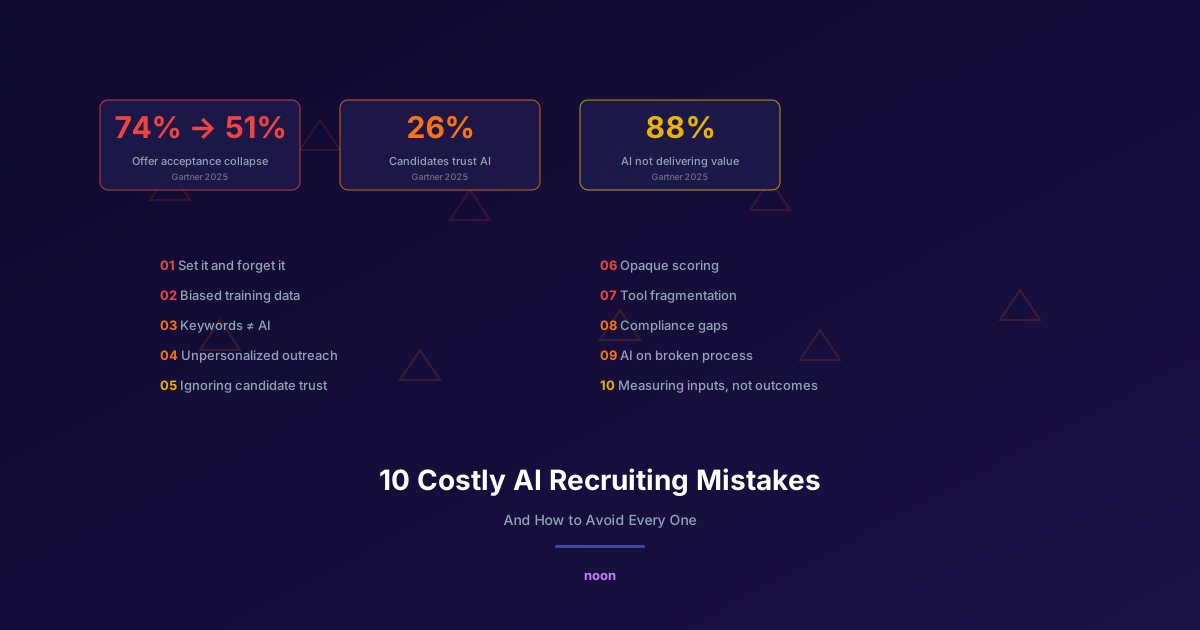
Key takeaway: The 10 costliest AI recruiting mistakes are: over-automating human-judgment tasks, ignoring candidate trust (only 26% trust AI in hiring), skipping bias audits, using AI for screening without explainability, neglecting the candidate experience, failing to calibrate models, replacing recruiters instead of augmenting them, ignoring compliance (EU AI Act, NYC LL 144), buying features instead of outcomes, and not measuring ROI.
AI in recruiting is producing a paradox. Adoption is accelerating — 84% of talent leaders plan to use AI in 2026 according to Korn Ferry — while outcomes are deteriorating. Candidate offer acceptance rates dropped from 74% in 2023 to 51% in 2025, according to Gartner's survey of 3,000 job candidates. Only 26% of candidates trust AI to evaluate them fairly.
These aren't growing pains that will resolve with better technology. They're mistakes in how teams implement, manage, and rely on AI. The technology itself is capable of dramatic improvements in recruiting efficiency. The failures are in deployment. Our guide to AI recruiting covers the strategic foundations, while this article focuses specifically on the most common implementation mistakes we see in 2026.
Here are the 10 most costly AI recruiting mistakes we see teams making in 2026 — and how to avoid each one.
Mistake 1: Set it and forget it
The most common mistake is treating AI like a one-time setup. Configure the tool, connect it to the ATS, upload job descriptions, and walk away. This is how AI drift happens.
AI drift occurs when the system's outputs gradually shift away from what you actually want. The model optimizes for patterns in the data it has, which may not reflect your current needs. A sourcing tool trained on last year's hires will keep finding people who look like last year's hires — even if the role, team, or market has changed.
The data: 88% of HR leaders told Gartner in October 2025 that their AI tools have not delivered significant business value. The primary reason: lack of ongoing calibration and management.
The fix: AI recruiting tools need continuous feedback. Every pass, every advance, every rejection should feed back into the model. Platforms that use reinforcement learning from human feedback (RLHF) are designed for this — the system adjusts its recommendations based on your ongoing behavior, not just the initial configuration. But even with RLHF, someone needs to review the system's output regularly to catch drift early.
At Noon, RLHF is the core mechanism. Every candidate interaction calibrates the model. But we also recommend that teams review Noon's sourcing patterns every 2-3 weeks to ensure alignment with evolving priorities.
Mistake 2: Training on biased historical data
AI doesn't create bias. It amplifies whatever bias exists in the data it learns from. If your historical hiring data skews toward candidates from certain schools, companies, or demographic groups, the model will reproduce those patterns.
The data: The iTutorGroup case is the canonical example. Their AI screening tool automatically rejected women over 55 and men over 60, resulting in a $365,000 EEOC settlement. The Mobley v. Workday class action — alleging that Workday's AI screening tools had discriminatory impact — went nationwide in May 2025.
The fix: Three approaches work together:
Train on behavior, not outcomes. Instead of training the model on "who got hired" (which reflects historical bias), train it on "who the recruiter advanced" in real-time. RLHF-based systems do this naturally — they learn from current recruiter judgment, not historical hiring patterns.
Regular bias audits. Analyze your AI's outputs by demographic group. Are candidates from certain backgrounds being systematically scored lower? NYC Local Law 144 requires annual bias audits for automated employment decision tools. Even if you're not in NYC, this is good practice.
Diverse training data. If your AI searches across a narrow database (LinkedIn only, for example), it inherits the demographic skew of that database. Multi-source tools that aggregate data across professional networks, GitHub, patents, publications, and company websites produce more diverse candidate slates.
Mistake 3: Over-relying on keyword matching disguised as AI
Many platforms market "AI-powered matching" when they're actually running keyword extraction with fuzzy matching. The candidate's resume contains "Python" and the job description says "Python" — that's a match. This isn't AI. It's string comparison from 2010.
The problem: Keyword matching produces high volumes of false positives and misses qualified candidates who describe their experience differently. A senior ML engineer whose resume says "developed production inference pipelines using PyTorch" won't match a keyword search for "machine learning" if the exact phrase doesn't appear.
How to tell the difference: Ask your vendor: Does matching change based on my feedback? Do different users get different results for the same search? Can the system explain why it recommended a specific candidate in contextual terms? If the answer to all three is no, you're using keyword matching, not AI.
The fix: Use systems that employ semantic understanding — embeddings, LLMs, or both. These models understand that "built inference pipelines" is relevant to an "ML engineer" search even without keyword overlap. And prefer systems that improve with feedback, so the matching gets better as you use it.
Mistake 4: Automating outreach without personalization
AI makes it trivially easy to send outreach at scale. And most teams use this capability to send the same template to hundreds of candidates with a name merge field swapped in. Candidates can spot this immediately.
The data: 63% of candidates reported receiving at least one AI-generated outreach message that felt impersonal or irrelevant (Talent Board 2025). Generic template outreach now averages below 5% response rates across most channels. Meanwhile, genuinely personalized messages — referencing specific candidate experience, explaining role fit — achieve 15-25% response rates.
The fix: AI should personalize, not just automate. Effective AI outreach does three things:
- References the candidate's specific work or background
- Explains why the role fits their trajectory
- Adapts the channel and timing based on candidate behavior data
At Noon, the AI generates what we call an "AI intro" — a personalized opening that references the candidate's actual experience and explains why they're a fit. This isn't a template with merge fields. It's a genuinely unique message for each candidate, generated by an LLM that has read their full profile and the job context. You can book a demo to see how personalized AI outreach compares to template-based approaches in real recruiting scenarios.
Mistake 5: Ignoring candidate trust and transparency
The Gartner data is stark: only 26% of candidates trust AI to evaluate them fairly. Another 25% say they lose trust in an employer the moment they learn AI is involved. Ignoring this erodes your employer brand and directly impacts offer acceptance.
Why it matters: You can have the best AI sourcing and screening in the world, but if candidates don't trust the process, they'll accept offers from companies that feel more human. The 23-point drop in offer acceptance (74% to 51%) is at least partially driven by candidate AI skepticism.
The fix:
- Be transparent. Tell candidates when AI is involved in the process. Not in the fine print — in the conversation. "We use AI to help us find great candidates, but every decision is made by a human" goes a long way.
- Provide explainable decisions. If AI is used in screening, the recruiter should be able to explain why a candidate was advanced or not in human-understandable terms. "The AI flagged your experience in B2B SaaS product management as a strong fit" is better than "the system scored you 83%."
- Maintain human touchpoints. Even in a heavily automated process, candidates should interact with real humans at decision points. AI can source, screen, and schedule — but the interview and offer should feel human.
Mistake 6: Using AI scoring without understanding what it measures
Many AI tools present a "match score" or "fit score" as a percentage. Recruiters use this as a shortcut — sort by score, review the top 10. But most teams don't know what the score actually measures.
The problem: Is it measuring keyword overlap? Semantic similarity? Predicted performance? Predicted likelihood to respond? Each of these is a different thing, and optimizing for the wrong one leads to bad outcomes. A candidate with a 95% keyword overlap score might be completely wrong for the role. A candidate with a 60% semantic similarity score might be perfect but using different terminology.
The fix: Ask your vendor what the score measures. If they can't explain it clearly, the score is unreliable. Better yet, use systems that provide reasoning alongside scores — "this candidate was recommended because of their 4 years of growth-stage B2B SaaS experience, which matches the hiring manager's preference pattern" — rather than just a number.
Mistake 7: Buying multiple point solutions instead of a coherent platform
The average enterprise recruiting stack includes 12-15 tools (Aptitude Research 2025). Sourcing tool, screening tool, outreach tool, scheduling tool, CRM, ATS, analytics platform. Each has its own AI, its own data silo, and its own version of the candidate profile.
The problem: When AI tools don't share data, each one is operating with partial information. Your sourcing tool finds candidates but doesn't know their outreach response history. Your outreach tool sends messages but doesn't know the recruiter's feedback preferences. Your ATS has the pipeline data but none of the AI intelligence that surfaced the candidates.
The data: 67% of TA leaders say their recruiting stack is "too fragmented" and plan to consolidate in 2026-2027 (Aptitude Research 2025).
The fix: Either consolidate to fewer tools with shared data layers, or ensure your tools have robust integrations that pass data bidirectionally. The most effective approach is a platform that handles sourcing, screening, outreach, and learning in a single system — so the AI has full context. When Noon sources a candidate, screens them, sends outreach, and receives a response, all of that data feeds into a single model. There's no data fragmentation.
Mistake 8: Ignoring compliance until it's too late
The regulatory landscape for AI in hiring changed dramatically in 2025-2026, and many teams are behind.
The regulatory landscape:
- EU AI Act classifies employment AI as "high-risk" — requiring conformity assessments, documentation, and human oversight
- NYC Local Law 144 mandates annual bias audits for automated employment decision tools
- Colorado AI Act (February 2026) requires impact assessments for high-risk AI
- Illinois AI Video Interview Act constrains AI video analysis
- The Mobley v. Workday class action sets precedent for AI screening liability
The fix: Before deploying any AI recruiting tool, conduct a compliance review. Key questions:
- Does the tool produce documentation sufficient for EU AI Act conformity assessment?
- Can it generate bias audit reports for NYC Local Law 144?
- Does it support configurable human-in-the-loop checkpoints for high-risk decisions?
- Can it produce explainable reasoning for every recommendation?
Noon's architecture generates an explainable reasoning chain for every candidate recommendation and maintains comprehensive audit trails of all AI decisions — designed for compliance readiness from the ground up.
Mistake 9: Expecting AI to fix a broken process
AI amplifies whatever process it's applied to. If your hiring process is slow, adding AI to a slow process makes it faster at being slow. If your job descriptions are vague, AI will source candidates against vague criteria. If your feedback loops are broken — hiring managers take two weeks to review candidates — AI will fill pipelines that go stale.
The fix: Before implementing AI, fix the process fundamentals:
- Job descriptions should include specific requirements, not vague platitudes
- Hiring managers should commit to 48-hour feedback turnaround times
- Pipeline stages should have clear criteria for advancement
- Someone should own the candidate experience end-to-end
Then apply AI to the fixed process. The impact will be 5-10x what you'd get from applying AI to a broken one.
Mistake 10: Measuring AI by inputs, not outcomes
Most teams measure their AI tools by activity metrics: candidates sourced, messages sent, screens completed. These are inputs, not outcomes. A tool that sources 500 candidates per week sounds impressive until you learn that only 3 make it past the recruiter screen.
The fix: Measure AI by outcomes that matter:
- Qualified candidates per week: Not total candidates surfaced, but candidates that pass the recruiter screen
- Response rates: Are outreach messages generating replies?
- Time to qualified pipeline: How long does it take to build a shortlist of genuinely qualified candidates?
- Interview-to-offer ratio: Are the candidates who make it to interviews actually getting offers?
- Quality of hire: 90-day and 180-day retention and performance ratings for AI-sourced hires
The teams getting the most value from AI recruiting are the ones that measure it by the same metrics they'd use to evaluate a human recruiter — not by how many activities the tool performed.
What's the common thread across AI recruiting mistakes?
All 10 mistakes share a root cause: treating AI as a magic box that you plug in and forget. AI in recruiting works when it's treated as a team member that needs onboarding, feedback, management, and accountability. The teams getting real value from AI are the ones investing in calibration, monitoring, transparency, and continuous improvement — not just implementation.
FAQ
Why are AI recruiting tools failing to deliver value? The primary reason is lack of ongoing calibration and management. 88% of HR leaders say their AI tools haven't delivered significant business value (Gartner 2025). Most teams configure the tool once and expect it to work indefinitely. AI needs continuous feedback, regular bias audits, and process alignment to deliver results.
How do I avoid AI bias in recruiting? Three strategies: (1) Train on current behavior rather than historical hiring outcomes. RLHF-based systems learn from ongoing recruiter feedback, not biased historical data. (2) Conduct regular bias audits — analyze outputs by demographic group. (3) Use multi-source data to avoid inheriting the demographic skew of any single platform.
Is it legal to use AI in hiring in 2026? Yes, but with increasing regulatory requirements. The EU AI Act classifies employment AI as high-risk. NYC Local Law 144 requires bias audits. Colorado requires impact assessments. Illinois constrains AI video analysis. Compliance requires explainable decisions, audit trails, human oversight, and regular bias monitoring.
How do candidates feel about AI in recruiting? Skeptical. Only 26% trust AI to evaluate them fairly (Gartner 2025). 25% lose trust in an employer upon learning AI is involved. Transparency — telling candidates how AI is used and maintaining human touchpoints — significantly improves candidate perception.
What's the single most important thing to get right with AI recruiting? The feedback loop. AI that learns from your behavior gets better over time. AI that runs on static rules degrades over time. Choose platforms with RLHF or similar mechanisms that adapt to your preferences, and commit to providing regular feedback. This single factor determines whether AI delivers compounding value or becomes an expensive inbox filler.