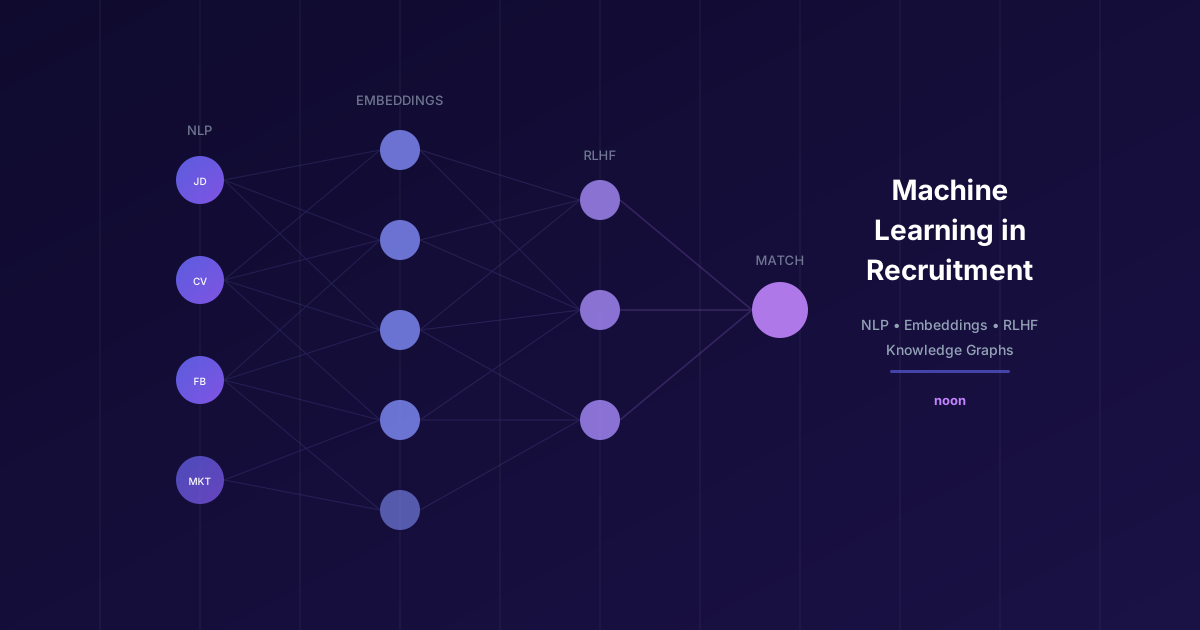
Key takeaway: Machine learning in recruitment uses four core techniques: NLP embeddings for semantic matching, reinforcement learning (RLHF) for calibration through recruiter feedback, knowledge graphs for career trajectory analysis, and supervised learning for predictive analytics like response and time-to-hire forecasting. Most platforms still use keyword matching from 2015. True ML-powered recruiting understands that a "Staff Engineer at Stripe" and a "Principal SWE at a Series D fintech" may be the same caliber — keywords miss this entirely.
Most recruiting platforms that claim to use "machine learning" are using the term loosely. They run keyword extraction against resumes, apply basic scoring rules, and present a ranked list. That's pattern matching, not machine learning.
Genuine ML in recruitment means the system changes its behavior based on outcomes. When a recruiter passes on a candidate, the model adjusts. When a hiring manager consistently favors candidates from certain project backgrounds over formal credentials, the system learns that preference. When outreach messages with a particular structure generate higher response rates for engineering roles but not sales roles, the model segments its approach. For broader context on how these techniques fit into modern hiring workflows, see our complete guide to AI recruiting.
This distinction matters because the gap between genuine ML and keyword matching is growing wider every year. A 2025 study from Columbia University (ConFit v3) demonstrated that embedding-based retrieval combined with LLM re-ranking significantly outperformed even GPT-5 and Claude on real-world person-job fit datasets. Meanwhile, most commercial ATS platforms are still running TF-IDF keyword overlap from 2015.
This article explains the specific ML techniques being used in modern recruitment technology, how they work under the hood, and what separates systems that genuinely learn from those that just sort.
Natural language processing: How machines read resumes and job descriptions
NLP is the foundation of every ML-powered recruiting system. The question is which generation of NLP the system is using.
Keyword extraction (2010–2018 era)
The simplest approach: parse a resume into tokens, extract named entities (job titles, company names, skills, degrees), and compare them against the job description.
How it works:
- Tokenize the resume text into individual words and phrases
- Use a skills taxonomy (often ONET or a proprietary dictionary) to identify recognized skills
- Compare extracted skills against the job description
- Calculate a match score based on overlap
Limitations: This approach fails on synonyms ("ML" vs. "machine learning"), context ("managed a Python migration" vs. "knows Python"), and doesn't capture career trajectory or role fit at all. A data analyst who used Python for basic scripting scores the same as a principal ML engineer on a Python-heavy team.
Most ATS platforms — Greenhouse, Lever, Workday — still operate at this level. Their "AI matching" is keyword overlap with fuzzy matching added.
Sentence and document embeddings (2019–2023 era)
The breakthrough came when NLP models learned to represent text as dense vectors — numerical representations that capture semantic meaning, not just keywords.
How it works:
- Feed the entire resume (or job description) through a transformer model (BERT, RoBERTa, or a domain-specific variant)
- The model outputs a vector — a list of 768 or more numbers — that represents the meaning of the document
- Compare candidate and job vectors using cosine similarity
- Candidates whose vectors are closest to the job vector rank highest
Why it's better: The model understands that "built and deployed production ML pipelines using PyTorch" is semantically close to a job description asking for "experience with deep learning frameworks in production environments" — even though they share almost no keywords.
Research from Alibaba's recruitment platform showed that embedding-based approaches improved click-through conversion rates by 19.4% compared to keyword methods in live A/B tests, saving millions in external headhunting costs.
Limitations: Embeddings capture semantic similarity but not fit. A resume that describes machine learning experience in academic research will be semantically similar to a job posting for an ML engineer at a startup — but the candidate may lack production engineering skills entirely. Similarity is not the same as suitability.
LLM-based contextual understanding (2024–present)
The current frontier uses large language models not just for embedding, but for reasoning about fit.
How it works:
- The LLM reads both the resume and job description in full context
- Instead of computing a single similarity score, it evaluates specific dimensions: Does this candidate's experience level match? Are their projects relevant? Do their career progression patterns suggest they'd succeed in this role?
- The system can explain its reasoning — "This candidate has the right technical skills but their last three roles were at large enterprises, and this position requires startup adaptability"
ConFit v3 (2025) demonstrated this approach using Qwen3-8B and Qwen3-32B models trained with reinforcement learning objectives on real recruitment data. The key innovation was multi-pass re-ranking: first retrieve candidates broadly using embeddings, then have the LLM evaluate the top results with full context. This hybrid approach outperformed both pure embedding methods and direct LLM evaluation.
Reinforcement learning: How systems learn from recruiter behavior
This is where machine learning in recruitment gets genuinely powerful — and where most platforms fall short.
Traditional ML in recruiting is supervised: you train a model on historical hires and it learns to predict which candidates will get hired. The problem is that historical hiring data is biased, incomplete, and often reflects bad decisions as much as good ones.
Reinforcement learning from human feedback (RLHF) takes a different approach.
How RLHF works in recruiting
Instead of learning from historical outcomes, the system learns from ongoing recruiter and hiring manager behavior:
- The system presents candidates to a recruiter. This is the "action" in RL terminology.
- The recruiter provides feedback — advancing a candidate, passing, requesting more like this one, or providing explicit ratings. This is the "reward signal."
- The model updates its policy — adjusting which features it weights more heavily, which candidate profiles it surfaces, and how it interprets the job requirements.
- The next batch of candidates reflects these adjustments. The cycle continues.
The critical difference from supervised learning: RLHF doesn't just predict what a recruiter would have done in the past. It optimizes for what a recruiter wants right now, for this specific role, based on their demonstrated preferences.
Why this matters in practice
Consider a search for a senior product manager. The job description says "5+ years PM experience, B2B SaaS, data-driven." A keyword system surfaces anyone with those terms. An embedding system finds semantically similar profiles. But neither adapts when the hiring manager reviews the first batch and passes on everyone from large enterprises, showing a clear preference for candidates from Series B–D companies.
An RLHF-based system captures that signal. The next batch skews toward growth-stage candidates — without anyone manually updating the search criteria. After three rounds of feedback, the system has built a nuanced understanding of what this particular hiring manager means by "senior PM" that goes far beyond the job description.
At Noon, RLHF is central to how the platform works. Every pass, advance, and outreach response feeds back into the matching model. The system doesn't just get better over time in a generic sense — it calibrates to each recruiter's specific preferences, each hiring manager's unstated criteria, and each company's cultural signals. Teams evaluating whether these ML capabilities fit their hiring workflow can book a demo to see how the reinforcement learning model adapts to feedback in real time.
The cold start problem and how to solve it
The challenge with RLHF is that it needs feedback to work. A brand new role with no feedback has no signal to learn from. This is the cold start problem.
Modern approaches solve this several ways:
- Transfer learning across similar roles: If the system has learned preferences for 50 previous PM searches, it can initialize a new PM search with aggregated insights from those searches
- Active learning: Instead of surfacing a random initial batch, the system deliberately presents diverse candidates that will maximize the information gained from the recruiter's feedback
- Hierarchical models: Learning happens at multiple levels — company-wide preferences, team-level preferences, and role-specific preferences — so a new role inherits relevant learning from higher levels
Knowledge graphs: Connecting the dots between skills, roles, and career paths
A knowledge graph maps relationships between entities — skills, job titles, companies, industries, education programs — in a way that pure text analysis cannot.
What a recruiting knowledge graph contains
- Skill relationships: Python is a subset of programming languages. PyTorch is a deep learning framework that requires Python. MLOps includes model deployment, monitoring, and CI/CD for ML pipelines.
- Career path patterns: Data Analyst → Data Scientist → Senior Data Scientist → ML Engineer is a common trajectory. Product Manager → VP Product → CPO is another.
- Company context: Google's L5 engineer is roughly equivalent to Meta's E5. A "VP" at a 20-person startup is not the same as a VP at Goldman Sachs.
- Education signals: A Stanford MS in CS carries different weight for a research role than for a sales engineering role.
How knowledge graphs improve matching
When a recruiter searches for "ML Engineer with 3+ years of experience," a keyword system looks for those exact terms. An embedding system looks for semantically similar profiles. A knowledge graph-enhanced system understands that:
- A candidate with "Applied Scientist" as their title at Amazon likely has ML engineering experience, even if they never held the title "ML Engineer"
- 2 years at a fast-paced AI startup may represent equivalent experience to 4 years at a large enterprise
- A candidate with strong PyTorch and Kubernetes experience but no MLOps title likely has MLOps capabilities
This kind of reasoning requires structured knowledge that pure NLP cannot extract from text alone.
Predictive analytics: Forecasting outcomes, not just matching profiles
ML in recruitment increasingly includes predictive models that go beyond matching to forecast outcomes.
Likely-to-respond models
Not every qualified candidate will respond to outreach. Predictive models estimate response likelihood based on:
- Candidate activity signals: Recent job changes, profile updates, open-to-work status
- Outreach context: Time of day, day of week, channel (email vs. LinkedIn), message length
- Historical patterns: Response rates for similar candidates in similar roles
- Market conditions: How competitive the talent market is for this specific skill set
These models help prioritize outreach to candidates most likely to engage, rather than blasting the same generic message to everyone who matches on paper.
Time-to-hire prediction
By analyzing historical hiring data, ML models can predict how long a search will take based on:
- Role seniority and specialization
- Compensation competitiveness relative to market
- Geographic constraints
- Current market supply for the required skill set
This helps hiring teams set realistic expectations and identify when a search is likely to stall.
Quality-of-hire prediction
The most ambitious application: predicting not just who will get hired, but who will succeed after being hired. This requires connecting recruiting data with post-hire performance data — which most organizations don't do systematically.
The few systems that have built this loop report significant improvements. LinkedIn's research has shown that combining recruiter behavior signals with post-hire retention data improves match quality by 30-40% compared to using either signal alone.
How does Noon use machine learning differently?
Most platforms use ML as an add-on feature — a matching score layered on top of a fundamentally manual search workflow. Noon's architecture is different because ML isn't a feature; it's the operating system.
Embedding-based retrieval: Noon uses vector embeddings (stored in Turbopuffer, a purpose-built vector database) to semantically search across candidate profiles. This means a search for "someone who can build data pipelines" finds candidates with ETL experience, Airflow expertise, and data engineering backgrounds — not just people who happen to have "data pipeline" in their profile.
RLHF calibration: Every interaction feeds back into the model. When you advance a candidate, the system learns what "good" looks like for this specific role. When you pass, it learns what to filter out. After 15-20 feedback signals, the system has built a calibrated model that reflects your unstated preferences — the things you know you want but couldn't articulate in a job description.
Multi-channel outreach optimization: Noon's ML models don't just find candidates — they determine the optimal way to reach them. Which channel (email vs. SMS), what time, what message structure, what level of personalization. These models learn from aggregate response data across thousands of outreach sequences.
Non-negotiable enforcement: Noon uses LLM-based screening to evaluate candidates against mandatory criteria (immigration status, clearance requirements, specific certifications) with contextual understanding — not just keyword presence. The system doesn't just check if "security clearance" appears in the profile; it evaluates whether the candidate's background suggests they hold or could obtain the required clearance.
What's the gap between ML marketing claims and reality in recruiting?
The recruiting technology market is flooded with "AI-powered" platforms. Here's how to evaluate whether a system is using genuine ML or just using the term for marketing:
Signs of genuine ML:
- The system measurably improves with feedback over time
- Recommendations change based on your behavior, not just your search criteria
- The platform can explain why it recommended a specific candidate in contextual terms, not just keyword overlap
- Results differ between users searching for the same role, reflecting learned preferences
Signs of keyword matching wearing an ML label:
- Every user gets the same results for the same search query
- The system requires you to manually adjust filters to refine results
- "AI matching" is a percentage score based on resume-to-JD similarity
- The platform can't explain its recommendations beyond listing matching keywords
- Results don't improve even after extensive use
FAQ
What types of machine learning are used in recruiting? The primary techniques are NLP for understanding resumes and job descriptions (including embeddings and LLMs), supervised learning for predicting outcomes (response rates, hire likelihood), reinforcement learning for adapting to recruiter feedback, and knowledge graphs for understanding skill and role relationships. Modern systems like Noon combine all four.
Does machine learning in recruiting introduce bias? Any ML system can amplify biases present in its training data. If historical hiring data reflects biased decisions, a model trained on that data will reproduce those biases. RLHF-based systems partially mitigate this because they learn from ongoing feedback rather than historical outcomes, but deliberate bias auditing and diverse training data remain essential.
How much data does a recruiting ML system need to be effective? For embedding-based matching, the model is typically pre-trained on millions of profiles and job descriptions before deployment. For RLHF calibration on a specific role, systems like Noon typically need 15-20 feedback signals (passes and advances) to meaningfully calibrate. For predictive models (response prediction, time-to-hire), aggregate data across thousands of searches provides the training signal.
Can ML replace recruiters? No. ML excels at finding, ranking, and reaching candidates at scale — tasks that are high-volume and repetitive. Recruiters excel at relationship building, negotiation, cultural assessment, and the judgment calls that require human context. The most effective approach is ML handling the sourcing and screening pipeline while recruiters focus on candidate experience and closing.
What's the difference between AI and ML in recruiting? Machine learning is a subset of AI. In recruiting, "AI" is often used loosely to describe any automated feature. "ML" specifically refers to systems that learn from data and improve over time. A chatbot that follows scripted responses is AI but not ML. A matching system that adapts based on recruiter feedback is ML. The distinction matters because only true ML systems deliver compounding value over time.