Key takeaway: AI adoption in HR jumped from 26% to 43% in one year, but most teams use AI for low-impact Tier 1 tasks like content generation. The highest-ROI AI applications for talent acquisition are autonomous sourcing (70-90% time savings), AI-powered screening (150+ resumes/hour), and predictive analytics for quality-of-hire. Deploy AI where it replaces mechanical work, not where it replaces human judgment.
Key takeaways:
- AI adoption in HR jumped from 26% to 43% in one year (SHRM 2025), but most teams use it for low-impact Tier 1 tasks like content generation.
- The highest-ROI applications are autonomous sourcing (70-90% time savings), AI screening (150+ resumes/hour), and predictive quality-of-hire analytics.
- Deploy AI where it replaces mechanical work, not where it replaces human judgment.
- Tier 1 content tools are table stakes; teams winning the talent war reach Tier 3-4 (autonomous sourcing and analytics).
SHRM's 2025 Talent Trends report found that 43% of companies now use AI for HR tasks — up from 26% a year earlier. That's a remarkable adoption curve. But "using AI for HR" covers an enormous range, from auto-generating job descriptions (low impact) to running autonomous sourcing campaigns (high impact). For a broader overview of how AI is transforming the entire recruiting function, see our guide to AI recruiting.
The teams getting outsized results aren't the ones with the most AI tools. They're the ones deploying AI strategically — at the specific points in the recruiting workflow where human effort is highest and where AI delivers the most measurable improvement.
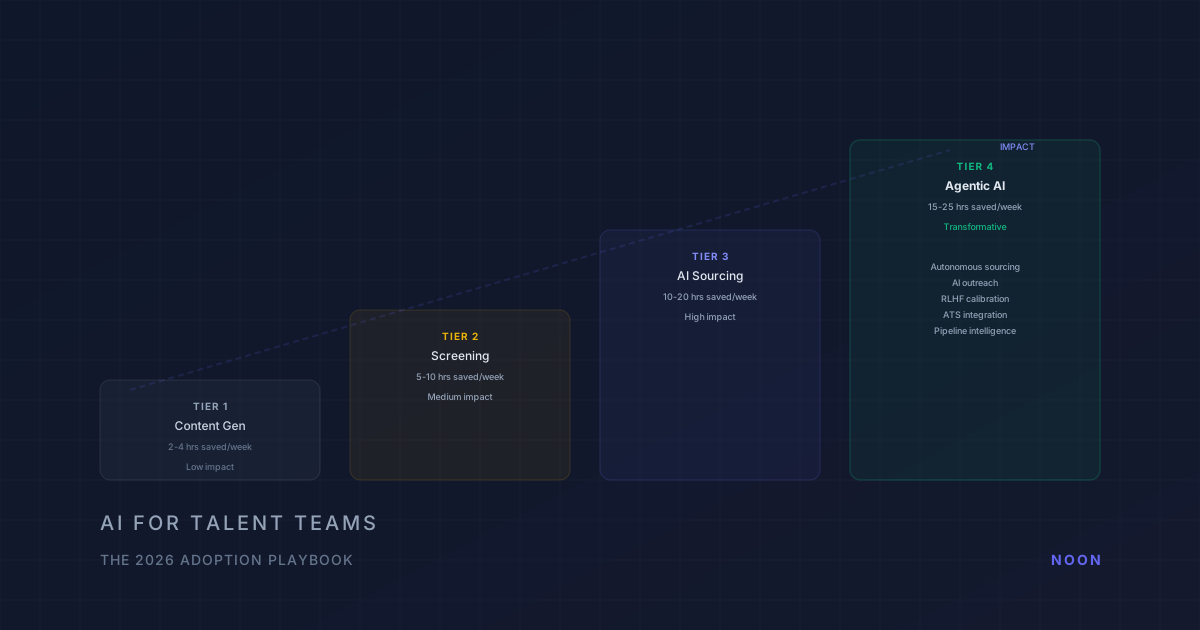
This playbook covers four tiers of AI adoption in talent acquisition, ordered by impact. Most teams start at Tier 1. The teams winning the talent war have reached Tier 3 or 4.
Tier 1: Content generation (Low impact, easy to deploy)
This is where most teams start — and where most teams stay too long.
What it includes:
- AI-generated job descriptions
- AI-drafted interview questions
- AI-written rejection emails and candidate communications
- AI-created employer branding content
Time savings: 2-4 hours per recruiter per week Cost savings: Minimal Impact on hiring outcomes: Negligible
The problem with staying at Tier 1: Writing job descriptions faster doesn't help you find more candidates. Better rejection emails don't reduce time-to-fill. Tier 1 AI improves efficiency on tasks that weren't the bottleneck in the first place.
When to move beyond Tier 1: Immediately. Use Tier 1 tools — they save time on admin — but don't mistake them for a recruiting AI strategy. They're table stakes, not a competitive advantage.
Tier 2: Screening and evaluation (Medium impact)
This is where AI starts moving actual recruiting metrics.
What it includes:
- AI resume screening that evaluates fit beyond keywords
- AI-assisted interview scoring and structured feedback
- Skills assessment automation
- Candidate qualification chatbots
Time savings: 5-10 hours per recruiter per week Cost savings: Moderate (reduced screening time, fewer unqualified interviews) Impact on hiring outcomes: Meaningful improvement in screen-to-interview conversion rates
Example: A team screening 200 applicants per role manually spends 8+ hours per role on initial reviews. AI screening that evaluates candidates against specific criteria — using NLP/LLM reasoning, not just keyword matching — can reduce this to about 80 minutes of review time (roughly 150 resumes/hour) while maintaining (or improving) quality.
Key consideration: AI screening works best when criteria are clearly defined. Vague requirements ("strong culture fit," "self-starter") produce vague AI evaluations. Specific requirements ("5+ years of distributed systems engineering," "experience managing a team of 8+") produce accurate screening.
Tier 3: Autonomous sourcing (High impact)
This is where AI creates a step-change in recruiting capability.
What it includes:
- AI that proactively finds candidates across the web without recruiter search queries
- Multi-source discovery (LinkedIn, GitHub, personal sites, publications, conferences)
- Candidate evaluation using career trajectory analysis, company caliber signals, and skills inference
- RLHF-based matching that improves with hiring manager feedback
Time savings: 10-20 hours per recruiter per week Cost savings: Significant (reduced agency spend, lower cost-per-hire) Impact on hiring outcomes: Roughly 1.5x faster time-to-fill, up to 5x more candidates reviewed, measurably higher candidate quality
Why Tier 3 is transformative: Sourcing is the largest time sink in recruiting. Manual sourcing — writing Boolean searches, scrolling through LinkedIn profiles, evaluating candidates one by one — consumes 40-60% of recruiter time. AI sourcing compresses this to near-zero, while simultaneously expanding the search surface area beyond what any human recruiter could cover.
Noon's approach at this tier: When a role is activated, Noon's AI agent autonomously searches the web for matching candidates, evaluates them against role-specific criteria, and generates a ranked list of qualified prospects. The system uses RLHF to learn from hiring manager feedback, so matching quality improves with every review cycle. Recruiters spend their time calibrating the AI and engaging with pre-qualified candidates — not operating search tools. If you're evaluating autonomous sourcing platforms for your talent team, you can book a demo to see how Noon's AI agent handles the complete sourcing workflow.
Tier 4: End-to-end agentic recruiting (Transformative impact)
This is where AI handles the complete upstream recruiting workflow autonomously.
What it includes:
- Everything in Tier 3 (autonomous sourcing and evaluation)
- AI-personalized multi-channel outreach (email and SMS)
- Automated follow-up sequences with intelligent timing
- Response handling and candidate engagement management
- Real-time ATS sync with full audit trail
- Pipeline intelligence (which candidates are most likely to convert, when to re-engage)
Time savings: 15-25 hours per recruiter per week Cost savings: Dramatic (agencies largely eliminated for standard roles, lower cost-per-hire, fewer tools needed) Impact on hiring outcomes: Fundamental change in recruiting capacity and speed
What this looks like in practice: A recruiter activates a role, defines criteria, and the AI handles everything from sourcing to engaged candidate handoff. The recruiter's role shifts from operational execution to strategic direction — calibrating the AI, engaging with responsive candidates, selling the opportunity, and closing offers.
What does an AI adoption roadmap look like for talent teams?
Here's how to move through the tiers over 90 days:
Days 1-14: Deploy Tier 1 + evaluate Tier 2-3 options
- Implement AI writing tools for job descriptions and candidate communications (ChatGPT, Jasper, or built-in ATS features)
- Evaluate AI screening tools and autonomous sourcing platforms
- Identify your highest-pain-point roles for pilot deployment
Days 15-30: Launch Tier 2 screening pilot
- Deploy AI screening on 2-3 high-volume roles
- Measure impact on screening time and interview quality
- Calibrate screening criteria with hiring managers
Days 31-60: Activate Tier 3 autonomous sourcing
- Activate AI sourcing on 2-3 hard-to-fill roles
- Run the calibration/feedback cycle for 2-3 weeks
- Measure impact on pipeline volume, quality, and time-to-fill
Days 61-90: Expand to Tier 4 with outreach automation
- Activate AI-personalized outreach on calibrated roles
- Monitor response rates and engagement quality
- Scale to additional roles as results prove out
- Begin quantifying total ROI (time saved, agency spend reduced, hires accelerated)
Where should AI not replace humans in recruiting?
Despite the power of Tier 3-4 AI, certain recruiting tasks should remain human-driven:
Final interview decisions. AI can screen and evaluate, but the decision to hire someone should involve human judgment about team dynamics, cultural contribution, and long-term potential that AI can't fully assess.
Offer negotiations. Compensation discussions require empathy, reading between the lines, and creative problem-solving (sign-on bonuses, flexible start dates, equity packages) that are inherently human.
Candidate motivation. Understanding why a candidate would leave their current role, what they're optimizing for in their next move, and how to position your opportunity accordingly requires conversational nuance.
Relationship building with hiring managers. Translating vague hiring requirements into actionable criteria, managing expectations, and building trust requires human partnership.
Ethical judgment calls. Decisions about candidate accommodations, privacy requests, and fairness concerns should always involve human review.
How do you measure AI's impact on recruiting outcomes?
Track these metrics before and after AI deployment:
| Metric | Pre-AI baseline | Tier 1 | Tier 2 | Tier 3 | Tier 4 |
|---|---|---|---|---|---|
| Recruiter hours/role/week | 12-20 | 10-16 | 8-12 | 4-8 | 2-5 |
| Time-to-fill | 44+ days | 42 days | 38 days | 28 days | 20-25 days |
| Cost-per-hire | $5,475 | $5,200 | $4,500 | $3,200 | $2,000-2,800 |
| Candidates reviewed/week | 30-50 | 30-50 | 50-80 | 80-150 | 100-200+ |
| Agency dependency | 30-40% of hires | 30-40% | 25-30% | 10-15% | 5-10% |
Frequently asked questions
Should we build or buy AI recruiting capabilities? Buy. Building a competitive AI sourcing or screening system requires ML engineering expertise, training data, and ongoing model development that makes no sense for a recruiting team to own. The buy vs. build math is unambiguous here — buy a purpose-built platform and focus your team's energy on using it effectively.
How do we get hiring manager buy-in for AI recruiting? Start with results, not pitches. Deploy AI on one role with a willing hiring manager, demonstrate measurable improvement (faster candidate delivery, higher quality, less hiring manager time), then use that success story to expand. Peer evidence is more convincing than vendor demos.
What's the biggest risk of AI in recruiting? Bias amplification. AI systems trained on biased data will perpetuate those biases at scale. Mitigate by: choosing platforms with built-in bias monitoring, auditing results across demographic dimensions, and maintaining human oversight of final hiring decisions.
Can small teams benefit from AI recruiting tools? Yes — arguably more than large teams. A 2-person recruiting team managing 30 open reqs benefits enormously from autonomous sourcing and screening. The relative time savings are even greater than for a 50-person TA team, because each recruiter carries a disproportionate workload.