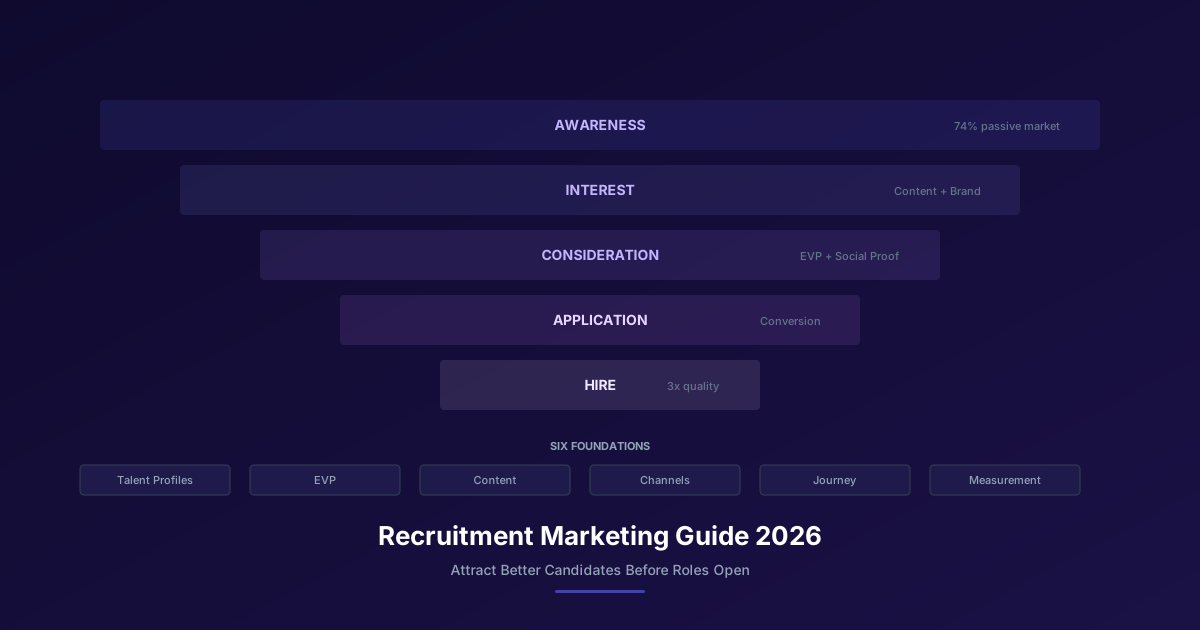
Key takeaway: Recruitment marketing attracts candidates before they apply by building employer brand awareness, creating valuable content, and nurturing talent communities. With 74.4% of the talent market passive, job postings alone reach only 25.6% of potential candidates. Effective recruitment marketing matches content and channels to specific talent profiles — from culture content to career opportunity content — and measures results through awareness, engagement, pipeline, and quality metrics.
Post a job. Wait for applicants. Review the pile. This is how most companies recruit. And it's increasingly a losing strategy.
The problem is simple: 74.4% of the reachable talent market are passive candidates (AIHR 2025). They're not browsing job boards. They're not updating résumés. They're employed, reasonably satisfied, and not actively looking. A job posting only reaches the 25.6% who are — and even within that pool, the best candidates are claimed within days.
Recruitment marketing applies marketing principles to talent acquisition. Instead of waiting for candidates to find you, you build awareness, interest, and engagement before roles open — so when a position becomes available, qualified people already know who you are, what you stand for, and why they might want to work with you.
Companies that invest in recruitment marketing see a 3x increase in candidate quality (AIHR). They reduce cost-per-hire by 43% (LinkedIn). They fill roles 50% faster than companies that rely solely on reactive posting (Aptitude Research). Yet only 44% of companies measure recruitment marketing ROI — suggesting most organizations are either not doing it or doing it without knowing whether it works.
This guide covers how to build a recruitment marketing strategy from scratch: defining your employer brand, creating content that resonates, choosing channels that reach your target candidates, and measuring what actually works.
Recruitment marketing vs. employer branding vs. sourcing
These terms get conflated. They're related but distinct:
Employer branding defines who you are as an employer. What's the culture like? What do employees value? What's the mission? It's the foundation — the story you tell. Employer branding is a long-term investment in perception.
Recruitment marketing activates the employer brand to generate candidate demand. It's the campaigns, content, events, and channel strategy that put the brand in front of the right people. Recruitment marketing is a targeted practice.
Sourcing identifies and contacts specific individuals for specific roles. It's outbound, targeted, and role-specific. Sourcing finds people; recruitment marketing makes those people receptive when sourced.
The interplay: Strong employer branding makes recruitment marketing more effective, which makes sourcing more effective. A sourced candidate who already knows your company through marketing content responds at 2-3x the rate of a cold-sourced candidate with no brand awareness.
This is why recruitment marketing and AI sourcing are complementary, not competitive. At Noon, the AI sources and reaches out to qualified candidates. When those candidates already have positive brand awareness through recruitment marketing, outreach response rates are significantly higher. If you want to see how AI sourcing performs with your talent profiles, book a demo to run a test search.
The six foundations of recruitment marketing
1. Defined talent profiles
You can't market to "everyone." Effective recruitment marketing targets specific talent segments — the same way product marketing targets specific customer personas.
For each critical role type, define:
- Who are they? Demographics, experience level, current role, career aspirations
- Where do they spend time online? LinkedIn, GitHub, Reddit, Twitter/X, industry forums, podcasts
- What do they care about? Career growth, compensation, mission, flexibility, technical challenge, team quality
- What would make them leave their current job? Better comp, more autonomy, more interesting problems, stronger culture, growth opportunity
This isn't guesswork. Interview your best current employees in each role type: "Why did you join? What almost made you not join? Where do you spend time online? What would make you leave?"
2. Role-specific Employee Value Proposition (EVP)
Your EVP is the answer to "Why should someone work here?" — and the answer should be different for an engineer, a salesperson, and a designer.
Generic EVP (ineffective): "We're a fast-growing company with great culture and competitive compensation."
Role-specific EVP (effective):
- For engineers: "You'll work on ML problems at scale — our recommendation engine processes 50M requests per day. Stack: Python, PyTorch, Kubernetes. Two-pizza teams. Deploy to production your first week."
- For sales: "Average AE earns $185K OTE with 40% hitting accelerators. Sell to VP/C-suite at enterprise companies. 30-day sales cycle. No cold calling — marketing generates 80% of pipeline."
- For designers: "Design for 2M active users. Direct access to user research. Ship designs weekly, not quarterly. Design system is Figma-native. Report to a VP who was a designer."
Notice: each EVP speaks to what that specific persona cares about in language they use. Engineers want to know the stack and the scale. Salespeople want to know the comp and the deal cycle. Designers want to know about user access and shipping velocity.
Critical mistake to avoid: 43% of employers target ambitious, performance-driven profiles in their messaging, but only 21% of young professionals identify that way (Serendi 2026). Your EVP may be speaking to a candidate who doesn't exist. Validate it against your actual employees, not your aspirational culture.
3. Content strategy
Recruitment marketing content falls into four categories:
Culture content: Day-in-the-life videos, employee spotlight stories, team event recaps, "why I work here" narratives. This answers: "What's it actually like to work there?"
Thought leadership: Engineering blog posts, industry perspectives, research contributions, conference talks. This answers: "Are these people smart and interesting?"
Career opportunity content: Role descriptions written as marketing copy (not legal documents), growth path examples, compensation transparency, benefits breakdowns. This answers: "What's in it for me?"
Social proof: Glassdoor reviews, Great Place to Work certifications, diversity reports, employee referral testimonials. This answers: "Can I trust what they're telling me?"
Content mix guidance:
- 40% culture content (the highest engagement driver)
- 25% thought leadership (builds credibility and attracts senior candidates)
- 20% career opportunity content (direct recruitment marketing)
- 15% social proof (trust and validation)
4. Channel strategy
Match your channels to where your talent profiles spend time:
Engineering candidates:
- GitHub (contribute to open source, share engineering blog posts)
- Hacker News (participate in discussions, post in hiring threads)
- Twitter/X (engineering team sharing technical insights)
- Stack Overflow (employer profile, sponsored tags)
- Dev.to and Medium (engineering blog syndication)
Business and operations candidates:
- LinkedIn (the primary professional channel for non-technical roles)
- Instagram (culture content, day-in-the-life)
- Glassdoor (employer brand management)
- Industry podcasts (sponsorship, guest appearances)
- Events (virtual and in-person)
Broad reach:
- Career site (owned channel — optimize for SEO)
- Email nurture (candidate relationship marketing)
- Employee referral program (your employees' networks are your best channel)
- Blog content optimized for Google and AI search
5. Candidate journey design
Recruitment marketing doesn't end when someone clicks "Apply." The candidate journey includes every touchpoint from first awareness to offer acceptance:
Awareness → Interest → Consideration → Application → Evaluation → Offer → Onboarding
At each stage, ask: What does the candidate need to know? What questions do they have? What concerns might stop them from progressing?
- Awareness: "I've heard of this company" → Content that introduces your mission and culture
- Interest: "They seem interesting" → Deeper content — engineering blog, employee stories, specific team insights
- Consideration: "Would I actually work there?" → EVP-specific content, compensation data, growth paths
- Application: "I want to apply" → Frictionless application process (under 5 minutes)
- Evaluation: "Am I being treated well?" → Fast communication, transparent process, respectful interviews
- Offer: "Should I accept?" → Personalized selling, address concerns, competitive package
- Onboarding: "Did I make the right choice?" → Strong first week, buddy system, early wins
6. Measurement and optimization
Only 44% of companies measure recruitment marketing ROI. Without measurement, you're spending budget on hope.
Metrics to track:
- Awareness metrics: Career site traffic, social media followers, brand search volume, content impressions
- Engagement metrics: Content engagement rate, career site time-on-page, email open/click rates, event attendance
- Pipeline metrics: Applications per source, source-to-hire ratio, career site conversion rate
- Quality metrics: Quality of hire by source, offer acceptance rate by source, 12-month retention by source
- Efficiency metrics: Cost-per-application, cost-per-quality-hire, recruitment marketing ROI
The ultimate ROI formula: Recruitment Marketing ROI = (Value of hires from marketing sources - Total marketing spend) / Total marketing spend × 100
Attribution challenge: Not every hire will directly attribute to a marketing touchpoint. Many candidates encounter your brand through marketing but apply through a different channel. Multi-touch attribution models (available in most marketing automation platforms) help connect the dots.
How AI sourcing and recruitment marketing work together
Recruitment marketing and AI sourcing aren't competitors — they're multipliers.
Marketing builds awareness. AI converts it.
When Noon's AI reaches out to a candidate who has already seen your company's engineering blog, heard your CTO on a podcast, and noticed your employees sharing team culture on LinkedIn — that outreach message has an entirely different reception than a cold message to someone who's never heard of you.
The data supports this: sourced candidates who have prior brand awareness respond at 2-3x the rate of cold-sourced candidates. Marketing doesn't replace sourcing. It makes sourcing work better.
The integrated approach:
- Recruitment marketing generates broad awareness and builds your reputation in target talent communities
- AI sourcing identifies specific individuals who match your hiring criteria
- When the AI reaches out, candidates have brand context — they know who you are and what you stand for
- Response rates increase. Offer acceptance rates increase. Quality of hire increases.
- Marketing analytics and sourcing data feed back to each other — which messages resonate with which talent segments
Common recruitment marketing mistakes
Treating it as a once-a-year campaign. Recruitment marketing is a continuous practice, not a campaign. Building employer brand takes months of consistent content and presence. Starting and stopping based on hiring volume means you're always rebuilding from zero.
Writing for yourself, not your candidates. Most career sites and recruitment content are written from the company's perspective — "We value innovation." Flip it: "You'll ship to production every week." Make the candidate the protagonist.
Ignoring Glassdoor and review sites. 86% of candidates research employer reviews before applying (Glassdoor). If your reviews tell a different story than your marketing, candidates will trust the reviews. Respond to negative reviews professionally. Address the underlying issues. The gap between marketing and reality is your biggest vulnerability.
Not measuring anything. If you can't attribute hires to marketing activities, you can't optimize or justify the budget. Start with simple source tracking and build toward multi-touch attribution.
FAQ
What is recruitment marketing? Recruitment marketing applies marketing principles to talent acquisition — building awareness, interest, and engagement with potential candidates before and during the hiring process. It includes employer branding activation, content creation, channel strategy, and candidate journey design. Companies with recruitment marketing strategies see 3x improvement in candidate quality (AIHR).
How is recruitment marketing different from job posting? Job posting is a single, reactive tactic — you post a role and wait for applicants. Recruitment marketing is a strategic, proactive practice — you build awareness and interest in your company as an employer across multiple channels, so that when roles open, candidates are already warm. Job posting reaches active seekers (25.6% of the market). Recruitment marketing reaches passive candidates (74.4%).
What content works best for recruitment marketing? Culture content (day-in-the-life, employee stories) drives the highest engagement. Thought leadership (engineering blogs, industry perspectives) attracts senior candidates. Career opportunity content (transparent role descriptions, growth paths) converts interest into applications. The recommended mix: 40% culture, 25% thought leadership, 20% career opportunity, 15% social proof.
How do I measure recruitment marketing ROI? Track four tiers: awareness (career site traffic, social followers), engagement (content interaction rates), pipeline (applications by source), and quality (quality of hire by source, retention by source). The ultimate formula: ROI = (Value of marketing-sourced hires - Marketing spend) / Marketing spend × 100.
Does recruitment marketing replace sourcing? No — they're complementary. Recruitment marketing builds awareness so that when sourcing tools like Noon reach out to candidates, those candidates already know your company. Sourced candidates with prior brand awareness respond at 2-3x the rate of cold-sourced candidates. The most effective teams run both in parallel.